Aluminium Door Technology: What’s Actually Changed, and What’s Coming
Aluminium door technology has shifted in three concrete, verifiable directions over the past several years: better thermal performance through advanced thermal break design, stronger multi-point security hardware, and materials specified for Dubai’s specific climate stresses rather than generic imports. This guide covers what’s genuinely in use in UAE construction today, what’s still emerging, and how to tell the difference when a contractor tells you something is “the latest technology.”
For current door options and specifications, see our aluminium doors service page.
Quick Answer: What’s Real vs. Marketing
| Claim you’ll hear | Status | What to actually ask |
|---|---|---|
| “Thermal break technology” | Available now, well-established | Ask which thermal break method (polyamide strip vs. polyurethane pour) and its measured thermal performance |
| “Multi-point locking” | Available now, standard on quality hinged doors | Ask how many locking points and where they engage on the frame |
| “Marine-grade / corrosion-resistant hardware” | Available now, especially relevant for coastal properties | Ask for the specific hardware coating or grade, not just the label |
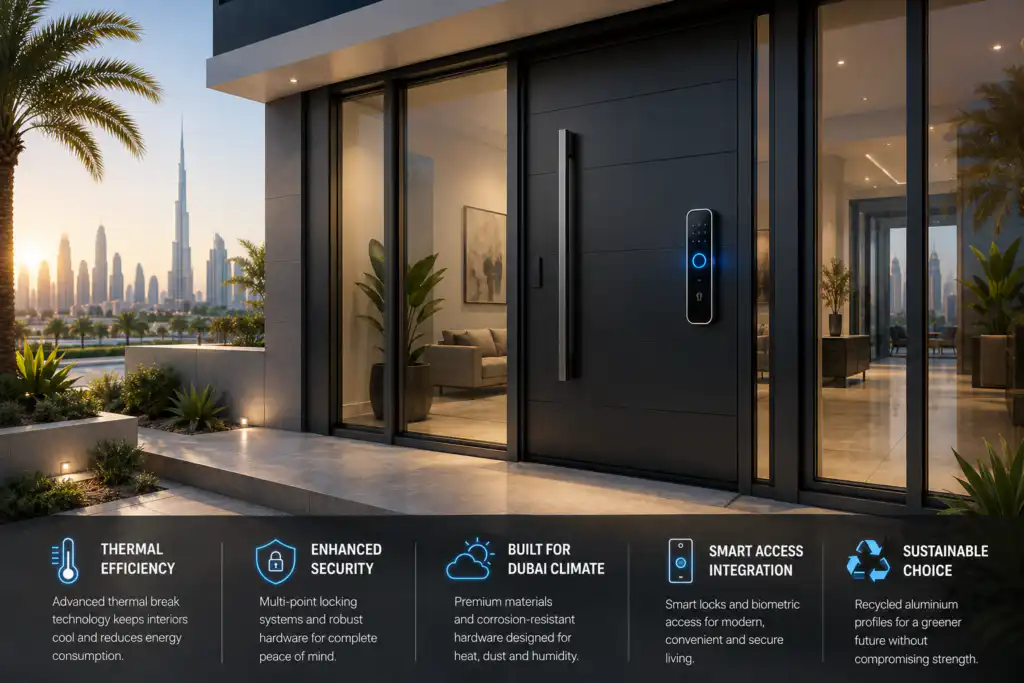
| “Smart lock / biometric integration” | Emerging in the broader market, not yet standard | Ask specifically whether this is a door-integrated feature or a separate add-on retrofitted to standard hardware |
| “Self-cleaning glass coating” | Emerging, available on some premium glazing suppliers | Ask which coating technology and whether it’s proven in high-dust environments like Dubai, not just marketed for temperate climates |
| “Recycled aluminium content” | Increasingly available, worth asking about directly | Ask for the actual recycled content percentage, not just “eco-friendly” as a general claim |
Available Now: Thermal Break Design
Thermal break technology isn’t new, but the engineering behind it has genuinely improved. The core method — inserting a polyamide strip between the interior and exterior aluminium profile to interrupt direct heat conduction — has been standard for over a decade. What’s changed is the shift toward multi-chamber profile designs, where the frame itself contains multiple internal air chambers rather than a single cavity, further reducing heat transfer beyond what the thermal break strip alone achieves.
This matters specifically in Dubai because cooling load, not heating, dominates energy use — a well-designed thermal break door reduces the heat entering through the frame itself, on top of whatever the glazing achieves. It’s also increasingly factored into compliance requirements under Dubai’s Al Sa’fat Green Building Rating System for building envelope performance on newer developments.
Available Now: Multi-Point Locking Hardware
Older single-point locking (one bolt, one location) has been largely superseded by multi-point systems that engage the door frame at three or more points simultaneously — typically at the top, middle, and bottom of the door — when the handle is turned or key engaged. This distributes locking force across the full height of the door rather than concentrating stress at one point, which improves both security resistance and long-term frame alignment, since the door isn’t relying on a single fixing point to stay true over years of daily use.
Available Now: Climate-Specific Hardware Grading
This is less a single innovation than a shift in specification practice: rather than using generic hardware regardless of location, hardware is increasingly specified by exposure grade — standard for inland/sheltered properties, marine-grade corrosion-resistant for coastal areas (Dubai Marina, JBR, Palm Jumeirah, the Sharjah and Ajman coastlines). This addresses a real, common failure mode in the UAE: standard-grade hinges and rollers that begin to seize or corrode within 1–2 years in salt-air-exposed locations. Ask any contractor directly whether hardware grade is being matched to your specific property’s exposure, rather than assumed.
Emerging in the Market: Smart Access Integration
Smart locks, app-based access control, and biometric entry systems are increasingly available in the broader UAE construction and retrofit market, particularly for villas and boutique commercial properties. These are generally integrated as an add-on to a standard door and lock mechanism rather than a fundamentally different door type — meaning the door itself (hinged, sliding, etc.) stays the same, and the access control layer sits on top of it. When evaluating this, the meaningful question isn’t whether a contractor “offers smart doors” as a category, but whether they can integrate a specific access system into a specific door type cleanly, with hardware that’s actually rated for outdoor UAE conditions rather than adapted from indoor-rated products.
Emerging in the Market: Advanced Glazing Coatings
Beyond standard Low-E coatings (already well-established for solar heat reduction), the broader glazing market is developing self-cleaning coatings that use a photocatalytic reaction to break down organic residue, reducing how often exterior glass needs manual cleaning. These are more proven in temperate, rain-frequent climates than in Dubai’s dry, dusty conditions, where the main soiling factor is windblown sand and dust rather than organic buildup — so their real-world performance benefit here is less established than in markets where they were originally developed and tested.
Emerging in the Market: Recycled Aluminium Content
Sustainability specification is becoming a more explicit part of UAE construction procurement, particularly on projects targeting green building certifications. Recycled aluminium content varies significantly by supplier and profile system, and “eco-friendly” as a marketing term without a stated percentage is not a meaningful specification — if sustainability credentials matter for your project (for certification purposes or otherwise), ask for the actual recycled content figure from whoever is fabricating your doors.
How to Evaluate a Contractor’s Technology Claims
- Ask for the mechanism, not just the label. “Thermal break” and “multi-point locking” are specific engineering features with measurable characteristics — a contractor who can explain how they work is more credible than one who lists them as buzzwords.
- Ask what’s climate-tested for the UAE specifically, not just imported from a supplier’s general catalogue developed for a different climate.
- Separate the door itself from add-on technology (like smart locks) — these are often supplied and warrantied by different parties, which matters if something needs servicing later.
- Ask for numbers where they exist — recycled content percentage, thermal performance rating, number of locking points — rather than accepting general claims at face value.
Frequently Asked Questions
Is thermal break technology worth the extra cost in Dubai? Generally yes for exterior doors, since it reduces the heat conducted through the frame itself, which contributes to overall cooling load — see our full cost breakdown for how much it typically adds.
Are smart locks compatible with standard aluminium doors? In most cases yes, as an add-on to the door’s existing lock mechanism, though compatibility depends on the specific hardware and should be confirmed with whoever is supplying the access system.
What’s the difference between standard and marine-grade hardware? Marine-grade hardware uses corrosion-resistant coatings or materials designed to withstand salt-air exposure, relevant for coastal Dubai and Sharjah properties where standard hardware can begin corroding or seizing within 1–2 years.
Does recycled aluminium perform differently from virgin aluminium? Properly processed recycled aluminium performs equivalently in structural and thermal terms — the distinction is environmental/certification-related, not a performance difference.
Next Steps
For current door specifications and pricing, see our aluminium doors service page, or explore our guide to the 6 door types we install to see which specification fits your project.