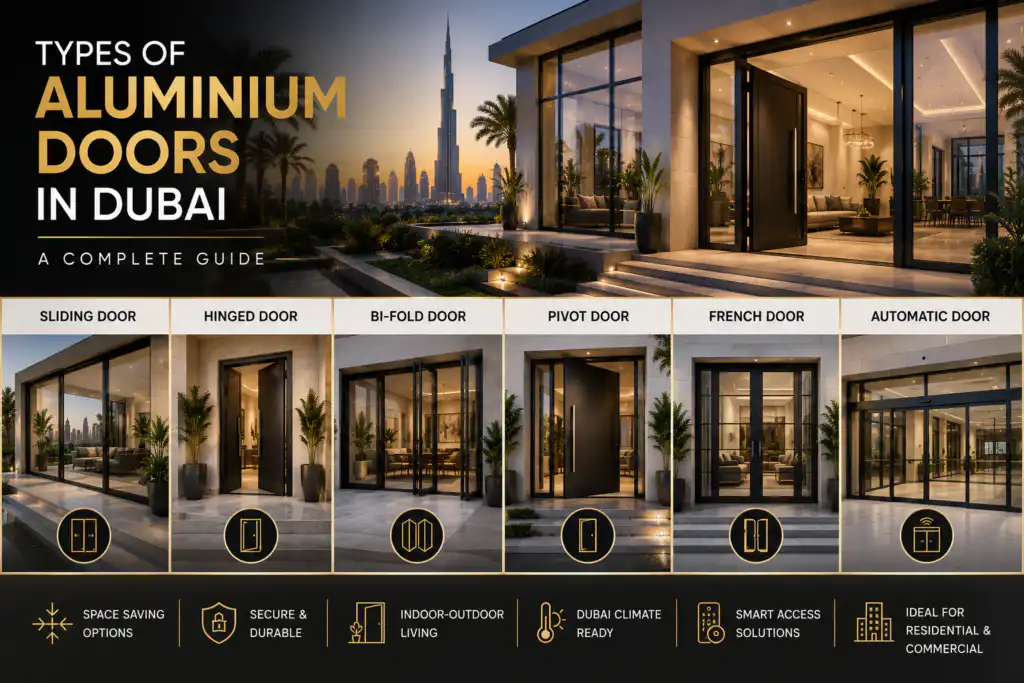
Dubai homes and businesses use six main types of aluminium doors: hinged (swing), sliding, bifolding, interior/divider, automatic sensor, and glass doors. Each is suited to a different opening, budget, and function — a villa entrance calls for a different door than a pool-facing living room wall or an office partition. This guide breaks down what each type is, where it works best, what it costs in Dubai, and how to decide between them.
Babar Dawood has manufactured and installed aluminium doors across Dubai, Sharjah, and Abu Dhabi since 2010. The pricing, specifications, and compliance information below reflect what we currently fabricate and install for residential and commercial projects in the UAE — see our full aluminium doors service page for specifications and a live quote.
Quick Answer: Which Aluminium Door Type Should You Choose?
| If you need… | Best door type | Typical starting price |
|---|---|---|
| A secure main entrance | Hinged (swing) door | AED 850/sq.m |
| To maximize a patio/balcony opening | Sliding door | AED 680/sq.m |
| To open an entire wall to a garden or pool | Bifolding door | See bifold doors page |
| An interior office/room partition | Divider door | Custom quote |
| Touchless access in a retail or hotel lobby | Automatic sensor door | AED 1,700/sq.m |
| Maximum light in a showroom or modern villa | Glass door | Custom quote |
1. Hinged (Swing) Doors
Best for: Villa entrances, offices, interior rooms
Hinged doors are the classic door mechanism — one or two panels mounted on side hinges, swinging open on a single axis. In Dubai, they remain the most common choice for main entrances because they offer the strongest, simplest sealing surface for multi-point security locking, which matters more at a front door than anywhere else in the property.
Pros:
- Best security-to-cost ratio of any door type — full-perimeter locking is easiest to engineer into a hinged frame
- Simple mechanism means fewer moving parts to service over time
- Available as single or double-door configurations for wider entrances
Cons:
- Requires interior and exterior clearance space to swing open — not ideal for tight hallways or furniture-crowded rooms
- Doesn’t maximize opening width the way sliding or bifold systems do
Cost in Dubai: From AED 850 per sq.m; front/entry doors specifically start from AED 3,000 per sq.m due to heavier profiles and premium hardware.
2. Sliding Doors
Best for: Patios, balconies, living areas, rooms with limited clearance
Sliding doors run on a horizontal track, making them the standard choice anywhere floor space is at a premium — balconies, poolside living rooms, and any indoor-outdoor transition where you don’t want a door swing eating into usable space.
Pros:
- No swing clearance needed — ideal for compact balconies and space-constrained layouts
- Large glass panels are easy to accommodate, maximizing natural light
- Generally the most budget-friendly door type per square metre in Dubai
Cons:
- Track systems collect desert dust and sand and need periodic cleaning to keep operation smooth (see our aluminium door maintenance guide for a cleaning schedule)
- Sealing against a moving panel is inherently less airtight than a fixed-frame hinged door, so thermal break specification matters more here
Cost in Dubai: From AED 680 per sq.m — typically the lowest starting price point of the six door types.
3. Bifolding Doors
Best for: Full-wall openings onto gardens, pools, or entertaining spaces
Bifolding doors use multiple hinged panels that concertina-fold flat against the wall when opened, allowing you to open an entire wall width rather than a single door-sized gap. In Dubai villas, this is the go-to choice for connecting an indoor living/dining area directly to a garden or pool deck.
Pros:
- Opens the widest possible span of any standard door system — ideal for entertaining and indoor-outdoor living
- Panels stack compactly, maximizing the usable opening when fully retracted
- Can be specified with thermally broken profiles to maintain energy efficiency despite the large glazed area
Cons:
- Higher cost than sliding or hinged doors due to the number of panels, hinges, and running gear involved
- Requires more precise installation to keep multiple panels aligned and operating smoothly over years of UAE heat cycling
Cost in Dubai: Custom-quoted based on span width and number of panels — see the dedicated bifold doors page for a full breakdown and current pricing.
4. Interior/Divider Doors
Best for: Offices, room partitions, architectural privacy screens
These are aluminium-framed doors designed for internal use — dividing an open-plan office into meeting rooms, or creating a defined room boundary without a full masonry wall. They’re typically specified with frosted or clear glass infill panels depending on how much privacy versus light transfer is needed.
Pros:
- Lighter-weight framing than exterior doors, since they don’t need to resist wind loads or weather
- Frosted, tinted, or clear glass options let you tune privacy precisely
- Faster and less disruptive to install than a stud wall, especially in occupied office fit-outs
Cons:
- Not weatherproofed — exterior-grade hardware and gasketing aren’t included, so these aren’t a substitute for external doors
- Acoustic performance is generally lower than a solid partition wall unless specified with double glazing
Cost in Dubai: Custom-quoted based on glass specification and hardware — request a quote for office fit-out pricing.
5. Automatic Sensor Doors
Best for: Retail entrances, hotel lobbies, high-traffic commercial spaces
Sensor-operated doors detect movement and open/close automatically, which is standard specification for Dubai retail, hospitality, and healthcare projects where touchless, accessible entry is expected.
Pros:
- Improves accessibility and hygiene in high-traffic commercial settings
- Reduces wear on manual hardware in doors that get opened hundreds of times a day
- Projects a modern, professional first impression for commercial tenants
Cons:
- Higher upfront cost than manual doors due to sensor and motor hardware
- Requires an accessible power supply and occasional servicing of the motor/sensor unit
Cost in Dubai: From AED 1,700 per sq.m.
6. Glass Doors
Best for: Showrooms, lobbies, modern villas
Glass doors use heavy-duty tempered or laminated safety glass with minimal aluminium framing, prioritizing openness and natural light over solid panel privacy. They’re common in retail storefronts and contemporary villa designs where an unbroken sightline matters.
Pros:
- Maximizes natural light and creates an open, contemporary aesthetic
- Tempered and laminated glass options are engineered to meet UAE safety-glazing standards
- Pairs naturally with matching glass partition or glass room installations for a consistent architectural look
Cons:
- Requires more frequent cleaning to stay smudge-free, particularly at commercial entrances
- Offers less thermal insulation than a solid-infill door unless specified with double glazing or Low-E coating
Cost in Dubai: Custom-quoted based on glass thickness and safety specification.
Glazing Options Across All Door Types
Whichever door type you choose, the glass specification behind it has a major impact on performance:
| Glazing type | Insulation level | Best use case |
|---|---|---|
| Single glazing | Basic | Internal/divider doors only |
| Double glazing | High thermal & acoustic | Villas, offices, external doors (recommended for most Dubai applications) |
| Double glazing + Low-E coating | Highest efficiency | Sun-facing façades, Dubai Marina/JBR high-rises |
| Tempered glass | Impact-resistant | Glass doors, shower-adjacent structural entries |
| Laminated glass | High-security, shatterproof | Ground-floor security applications, storefronts |
Why Thermal Break Matters for Dubai Doors
Standard aluminium conducts heat directly through the metal frame — in Dubai’s summer, that pushes indoor temperatures up and forces your AC to work harder. A thermal break is a polyamide strip inserted between the inner and outer frame that interrupts this heat path. We recommend it as standard for any villa, office, or ground-floor commercial entrance, and it’s factored into Dubai’s Al Sa’fat Green Building Rating System requirements for building envelope performance. Thermally broken profiles typically add 15–20% to upfront cost, offset over time by lower DEWA cooling bills.
Fire-Rated Aluminium Doors
For commercial buildings, hotels, and high-rises, fire-rated aluminium door systems are tested to withstand flame exposure for 30, 60, 90, or 120 minutes in line with standards such as BS 476 and Dubai Civil Defence requirements. These combine aluminium framing with fire-resistant cores and intumescent seals that expand under heat to block smoke and flame spread. If you’re specifying doors for a commercial fit-out, confirm fire rating requirements with your project consultant before finalizing door type.
How to Choose: A Decision Framework
Ask these four questions in order:
- Is this an exterior or interior opening? Exterior narrows you to hinged, sliding, bifolding, automatic, or glass. Interior points you toward divider doors.
- How much floor/swing clearance do you have? Tight clearance rules out hinged doors in favor of sliding or bifolding.
- What’s the primary use — security, light, or width? Security-first favors hinged; light-first favors glass or large sliding panels; width-first favors bifolding.
- What’s your budget band? Sliding and hinged doors are your most cost-effective starting points; bifolding, automatic, and fully glazed systems carry a premium for their added hardware and engineering.
For a full breakdown of what drives your final price up or down — size, glass spec, thermal insulation, and finish — see our guide on choosing cost-effective aluminium doors for your UAE property.
Frequently Asked Questions
What is the most common type of aluminium door in Dubai villas?
Sliding doors for patio and garden access, and hinged doors for main entrances, are the two most commonly installed types in Dubai villas.
Which aluminium door type is best for a small balcony?
Sliding doors, since they don’t require interior or exterior swing clearance the way hinged doors do.
Do all aluminium door types come with a warranty in Dubai? At Babar Dawood, every aluminium door installation — regardless of type — includes a 10-year insurance-backed warranty covering glass breakage, material and workmanship defects, and hardware issues.
Can aluminium doors be fire-rated?
Yes. Fire-rated aluminium door systems are available for commercial and high-rise projects, tested to withstand flame exposure for 30–120 minutes in line with BS 476 and Dubai Civil Defence requirements.
Are bifolding doors more expensive than sliding doors in Dubai?
Yes, generally. Bifolding doors involve more panels, hinges, and running gear, so they carry a higher cost than a comparable sliding door opening of the same width.
What’s the difference between a divider door and a glass door?
Divider doors are designed for internal, non-weatherproofed use like office partitions. Glass doors are typically exterior-rated, using tempered or laminated safety glass, and are built to withstand outdoor conditions.
Next Steps
Not sure which door type fits your project? Our team can walk you through the options based on your specific opening, budget, and building requirements — get a free quote or read our complete guide to choosing aluminium doors for your Dubai home for the full buying process. Once your doors are installed, our maintenance guide covers everything needed to keep them performing for the long term.