
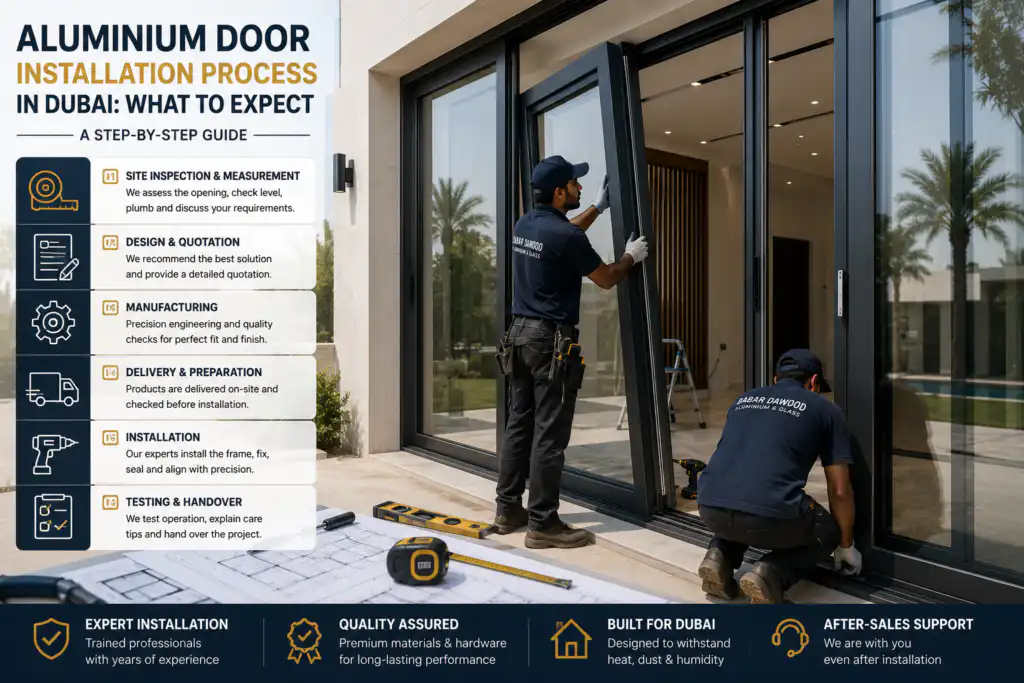
What Happens During a Professional Aluminium Door Installation in Dubai
A professional aluminium door installation in Dubai typically takes 1–3 days from arrival on site to handover, and follows five stages: site survey and measurement, fabrication, site preparation, installation and sealing, and final quality inspection. The exact timeline depends on door type, quantity, and whether the opening is new construction or a retrofit into an existing structure. This guide walks through what actually happens at each stage, what can go wrong without professional installation, and what to check before signing off on a completed job.
For pricing and door type options, see our aluminium doors service page. If you’re still deciding which door type fits your space, our types of aluminium doors guide covers all six options we install.
Quick Answer: The 5 Stages of Professional Door Installation
| Stage | What happens | Typical duration |
|---|---|---|
| 1. Site survey & measurement | Technician measures the opening, checks structural condition, confirms door type and glazing spec | 30–60 minutes |
| 2. Fabrication | Aluminium profiles are cut, welded/jointed, and glazed to the exact opening dimensions | 5–10 working days (off-site) |
| 3. Site preparation | Existing frame/door removed if retrofit; opening checked for level, plumb, and square | Half a day |
| 4. Installation & sealing | Frame fixed into the opening, sealed, hardware fitted, operation tested | Half a day to 2 days depending on door type and quantity |
| 5. Quality inspection & handover | Operation, sealing, and finish checked against spec; warranty documentation issued | 30–60 minutes |
Stage 1: Site Survey and Measurement
Before any fabrication begins, a technician visits the property to take precise measurements of the opening — width, height, and depth, plus checks for how level, plumb, and square the surrounding structure is. This matters more in the UAE than it might seem: many villas and older buildings have openings that are out of true by several millimetres, and an aluminium door frame fabricated to the nominal dimension rather than the actual on-site dimension won’t seal properly, leading to draughts, water ingress during rare rain events, and premature wear on hinges and rollers.
This is also when door type, glazing (single, double, or Low-E), thermal break specification, and hardware finish are confirmed against what’s discussed in your quote.
Stage 2: Fabrication
Once measurements are confirmed, the aluminium profiles are cut and jointed to the exact opening dimensions in a fabrication facility — not on-site. This is the longest stage of the process, typically 5–10 working days depending on door complexity and current order volume, because:
- Aluminium extrusions are cut and mitred to precise tolerances
- Corner joints are welded or mechanically fastened depending on the profile system
- Glass panels are cut, tempered/laminated as specified, and fitted into the frame
- Powder coating or anodizing is applied and cured before the frame leaves the facility
Custom sizes, fire-rated systems, and heavy-duty automatic sensor doors typically sit at the longer end of this range due to the additional hardware integration required.
Stage 3: Site Preparation
On installation day, if this is a retrofit (replacing an existing door), the old frame is removed first. The technician checks the opening again for level, plumb, and square — any deviation found here gets shimmed and corrected before the new frame goes in, rather than being compensated for after installation, which is a common source of long-term problems in poorly installed doors.
Stage 4: Installation and Sealing
The fabricated frame is fixed into the opening using mechanical fixings appropriate to the wall substrate (concrete, block, or steel structure), then sealed around the full perimeter with weatherproof sealant and EPDM gasketing to prevent water and air infiltration. Hardware — handles, locks, hinges, or motor/sensor units for automatic doors — is fitted and tested for smooth operation. For sliding and bifolding doors, tracks are checked for level across their full run, since even a slight incline affects long-term roller wear.
This stage is where the difference between DIY and professional installation shows up most clearly. A frame that isn’t correctly sealed and packed can look fine on day one but develop draughts, water staining, or hardware misalignment within months — and because the fabrication itself was custom-cut to a specific opening, retrofitting a poorly installed door isn’t always a simple fix.
Stage 5: Quality Inspection and Handover
Before handover, the completed installation is checked against the original specification: door operation (opening, closing, locking), seal integrity, glass condition, and finish quality. Warranty documentation is issued at this point — at Babar Dawood, every installation includes a 10-year insurance-backed warranty covering structural defects, glass breakage, and hardware or alignment issues, which is registered to the property at handover.
Why Professional Installation Matters More in the UAE
Three climate-specific factors make correct installation particularly important here:
- Thermal expansion: Aluminium expands and contracts more than other framing materials across Dubai’s wide temperature swings between day and night, and between winter and summer. Fixings and sealant joints need to be installed to account for this movement — incorrect fixing spacing is a common cause of long-term seal failure.
- Sand and dust infiltration: Poorly sealed frames allow fine desert sand into track systems and hardware, accelerating wear on rollers and locking mechanisms.
- Coastal humidity and salt air: In areas like Dubai Marina, JBR, and the Sharjah coastline, hardware not rated for corrosion resistance can begin to seize or discolor within a year or two if incorrectly specified or installed.
Cost of Getting Installation Wrong
| Problem | Common cause | Typical consequence |
|---|---|---|
| Draughts and water leaks | Opening not corrected for level/plumb before fixing | Ongoing energy loss, potential water damage over time |
| Hardware seizing early | Non-marine-grade fixings in coastal locations, or inadequate lubrication guidance | Repeat repair costs within 1–2 years instead of the expected 10+ |
| Doors not closing/locking properly | Frame installed out of square | Security risk, and often requires full frame removal to correct |
| Voided warranty | Self-installation or use of unlicensed contractor | No recourse if defects appear later |
DIY vs. Professional Installation: A Straight Comparison
| Factor | DIY / unlicensed installer | Professional installation (Babar Dawood) |
|---|---|---|
| Measurement accuracy | Relies on standard tools and general skill | Precision measurement against actual opening tolerances |
| Fabrication | Off-the-shelf or improvised sizing | Custom-fabricated to exact opening dimensions |
| Sealing & weatherproofing | Variable, often the most commonly missed step | EPDM gasketing and full-perimeter weatherproof sealing as standard |
| Warranty | None | 10-year insurance-backed warranty |
| Compliance (fire-rated, Al Sa’fat) | Not typically verified | Specified and installed to meet current Dubai/Abu Dhabi building code requirements |
| Time investment from you | Significant, plus risk of redoing work | Site visit to handover, fully managed |
Frequently Asked Questions
How long does aluminium door installation take in Dubai? Most residential installations take half a day to two days on-site, though the full process — including fabrication — typically spans 1–2 weeks from initial site survey to handover.
Can I install aluminium doors myself? It’s physically possible, but professional installation ensures accurate sealing, correct hardware setup, and warranty coverage — none of which apply to self-installed doors. See our comparison table above for what’s typically lost with DIY installation.
Do I need to be present during installation? It’s helpful but not required for the full duration — most clients are present for the initial site survey and final handover inspection, with fabrication and much of the on-site work happening independently.
What should I check before signing off on a completed installation? Confirm smooth door operation (opening, closing, and locking), check for visible gaps or uneven sealing around the frame perimeter, and make sure your warranty documentation has been provided.
Does installation include removal of my old door? Yes, for retrofit projects, removal of the existing frame and disposal is typically included as part of the installation service — confirm this is included in your specific quote.
Next Steps
Ready to schedule a site survey? Get a free quote for your project — or if you’re still comparing door types and pricing first, start with our guides on choosing the right aluminium door type and what drives aluminium door costs in the UAE. Once your doors are installed, our maintenance guide covers how to keep them performing for the long term.